
As an Amazon Associate, Ergoluma earns from qualifying purchases. Our guides are built from manufacturer-published specifications — we compare the spec sheets so you don’t have to.

Desk height is one of those things nobody thinks about until their neck hurts. The good news: the rule is simple, and it works for sitting and standing alike. Your desk should sit at or just below your elbow height, with your shoulders relaxed. Everything in this guide follows from that one sentence.
Sitting height: start with your elbows
Sit in your chair with your feet flat on the floor and your arms hanging relaxed at your sides. Bend your elbows to roughly 90 degrees. The height of your elbows above the floor is your ideal sitting desk height — for most adults, that lands between 28 and 31 inches.
This is why the standard fixed desk height is 29 to 30 inches (the DIN office standard specifies 74 cm, about 29.1 inches): it fits the middle of the population. But “the middle” leaves out a lot of people. If you’re 5’2″, your sitting elbow height is closer to 27 inches, and a 30-inch desk will have you shrugging all day. If you’re 6’4″, you need something closer to 32 inches. A fixed desk can’t serve both — which is the entire case for height-adjustable desks.
Standing height: higher than you think
Stand up straight, relax your shoulders, and bend your elbows to 90 degrees again. Your standing elbow height is your ideal standing desk height — typically 38 to 46 inches depending on your height and the work you’re doing.
Ergonomics references break it down by task: for light desk work (typing, reading), set the surface just below elbow height, around 34–37 inches for average adults. For precision work, slightly higher, around 39–43 inches. In practice, most people end up somewhere in the low 40s and fine-tune from there. The key insight: your standing desk height is roughly 12–14 inches above your sitting height. If a frame’s travel range can’t cover both of your numbers, it’s the wrong frame — check the specs before you buy (see our standing desk buying guide).
Quick reference: starting heights by body height

These are starting points based on average proportions — measure your own elbows for the final answer:
| Your height | Sitting desk height | Standing desk height |
|---|---|---|
| 5’2″ | ~27.5″ | ~38.5″ |
| 5’6″ | ~29″ | ~41″ |
| 5’10” | ~30.5″ | ~43.5″ |
| 6’2″ | ~32″ | ~46″ |
Notice the gap: sitting and standing heights differ by 11–14 inches. That’s the travel range your adjustable desk needs at minimum, centered on your two numbers.
Your monitor has a height too
Desk height means nothing if the monitor is wrong. The rule: the top of your screen should sit at or slightly below eye level, about an arm’s length away (20–28 inches from your eyes). You should gaze very slightly downward at the center of the screen — never crane your neck up, and never hunch down to read.
Laptop users, this one’s for you: a laptop on a desk puts the screen far below eye level, which is why necks hurt. A monitor arm or even a stack of books under the laptop (plus an external keyboard) fixes it. When you switch between sitting and standing, the monitor needs to move with the desk — another reason monitor arms earn their keep on standing desks.
The chair-desk handshake
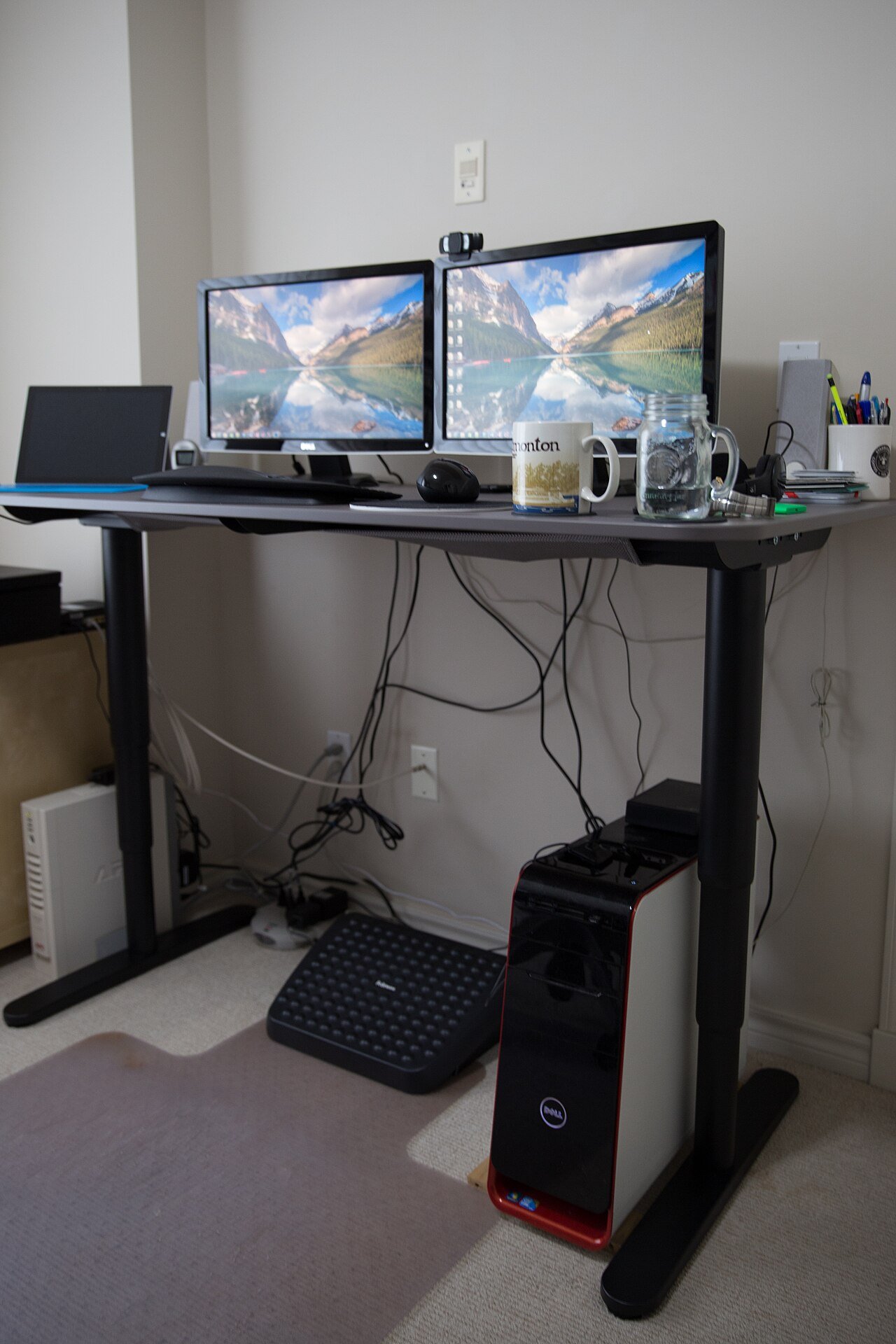
Desk and chair heights are a system, not two separate decisions. Set the chair first:
- Feet flat on the floor (or on a footrest if the chair has to go high).
- Thighs roughly parallel to the floor, knees at 90–110 degrees.
- Two to three inches of clearance between the seat edge and the back of your knees.
- Back against the backrest, using the lumbar support — not perched on the front edge.
Then set the desk to your elbow height in that seated position. If the desk is fixed and slightly too high, raise the chair and add a footrest rather than hunching your shoulders. Our chair buying guide covers which adjustments make this easy.
Alternate: the 20-8-2 rhythm

Once the heights are dialed in, the remaining question is how to split your time. Ergonomists often suggest a rhythm of roughly 20 minutes sitting, 8 minutes standing, 2 minutes moving — the point isn’t the exact ratio, it’s that neither position is held all day. Set a timer for the first week; after that, your body starts asking on its own.
Get the furniture right first — the right frame (see the desk guide), the right chair (see the chair guide) — and the habit becomes the easy part.
1 thought on “The Right Desk Height for Your Body”
Comments are closed.